

A powerful constituent relationship management (CRM) solution is a major investment, but its success isn’t guaranteed. A nonprofit CRM consultant is the expert partner you need to ensure your investment pays off. They help your organization bridge the gap between your needs and your technology, transforming a clunky database and frustrating processes into a streamlined experience that makes accessing and using your data effortless.
In this guide, we’ll discuss everything you need to know before investing in nonprofit CRM consulting. We’ll cover:
- Nonprofit CRM Consulting FAQ
- Nonprofit CRM Consulting Services
- The Process of Hiring a Nonprofit CRM Consultant: 3 Steps
- Partnering with DNL OmniMedia for Nonprofit CRM Consulting
If you need support for your next CRM implementation, want a dedicated expert to assess your current CRM processes, or require assistance with configuration and training, a nonprofit CRM consultant can provide the help you need. By the end of this guide, you’ll know everything you need to hire a consultant for your CRM needs, whatever they may be.
Nonprofit CRM Consulting FAQ
What is Nonprofit CRM Consulting?
A constituent relationship management (CRM) system, or donor database, is a solution for nonprofits to store information about their constituents and manage relationships with their communities. These tools are essential for engaging prospective and current stakeholders, including donors, beneficiaries, and volunteers, by providing a single, unified source of data for fundraising, marketing, and stewardship.
Since CRMs are such a critical tool, many nonprofits look for experts to assist them in handling or managing related tasks. That’s why many nonprofit consultants offer CRM consulting services, which aim to help nonprofits identify, use, and configure the tools that best meet their needs. Common CRM consulting services include assessing current workflows, recommending new CRMs to use, and overseeing the migration, but you can jump ahead for a more comprehensive list of CRM services.
Why Should I Hire a Nonprofit CRM Consultant?
Although it’s possible for nonprofits to handle CRM-related tasks and optimization themselves, most organizations can greatly benefit from expert assistance. Here are the primary reasons to invest in nonprofit CRM consulting:
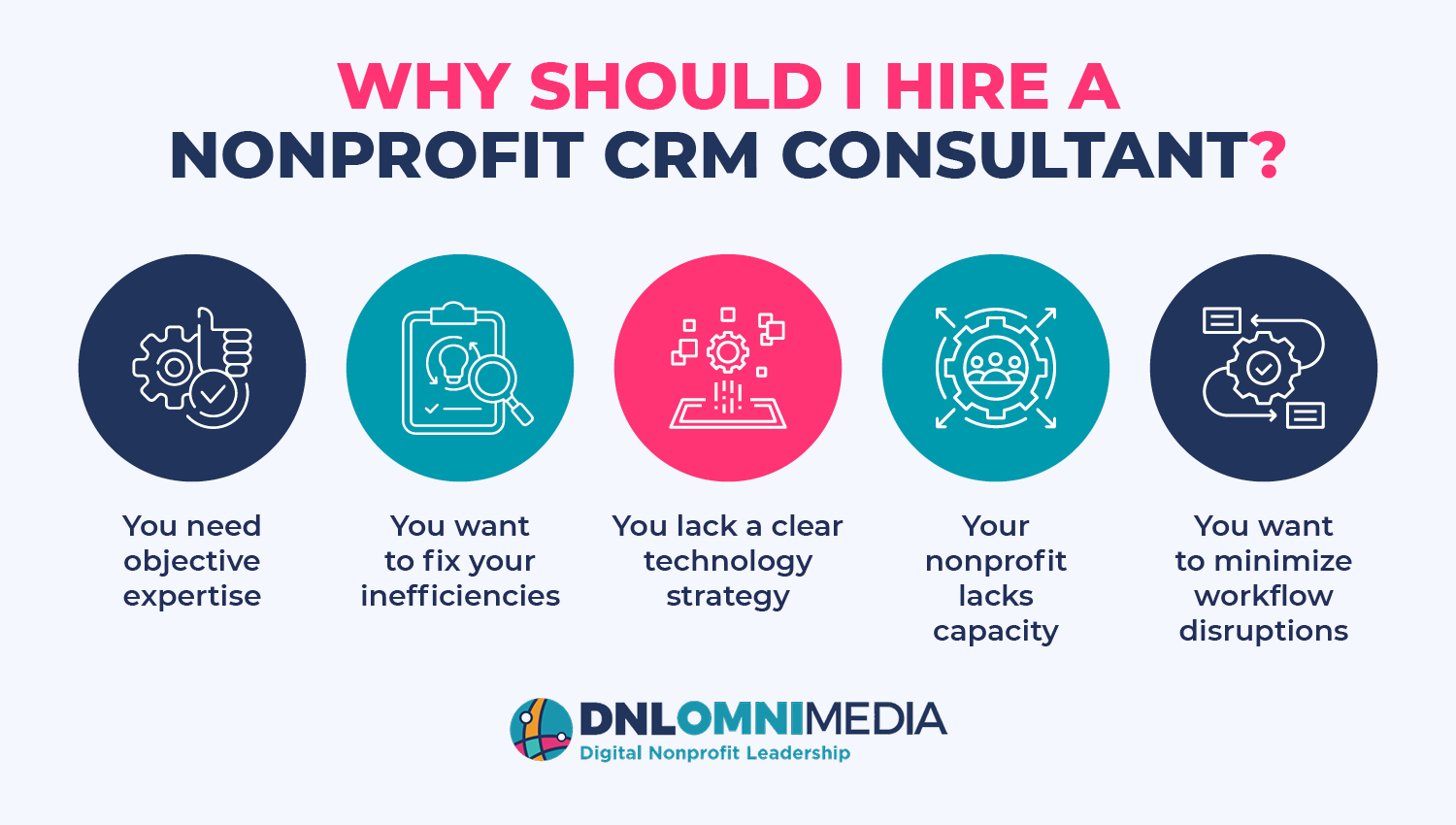
- You need objective expertise. If your team doesn’t have members who are well-versed in nonprofit technology, a CRM consultant can fill that knowledge gap. An objective third-party can also identify issues and solutions that your team members may overlook due to their proximity, resulting in more efficient problem-solving.
- You want to pinpoint and fix your inefficiencies. Your team may have frustrations with your current system or processes, but you might not know how to address them. For example, your CRM might require a lot of manual data entry, resulting in your team spending considerable time uploading gift amounts and documenting interactions. A consultant has encountered these issues before and can devise a fix.
- You lack a clear technology strategy. Maybe you don’t have a comprehensive CRM yet, and you use several discrete tools that don’t integrate with one another. Or, maybe you have a vague idea of what you want your technology stack to look like or do, but you’re not sure how to get there. Your nonprofit CRM consultant can assess your current tools and help you create a strategy for the future.
- Your nonprofit doesn’t have the capacity to handle it. Some nonprofits may have team members with software experience who could handle selecting and implementing a new CRM. However, not all organizations can spare the time. When you hire a consultant, optimizing your CRM is their top priority. You won’t have to worry about time being taken away from any of your team members who have other responsibilities to tackle.
- You want to minimize any workflow disruptions. Migrating to a new CRM can disrupt your work in a few ways, usually due to data or process failures. Nonprofit CRM consulting ensures that your migration is handled correctly and efficiently, so you can get up and running in your new database as quickly as possible. It also includes training for your team, so they can quickly learn how to use your new tools.
Even small organizations with minimal existing data can benefit from working with a CRM consultant. In this scenario, a consultant can advise on tools that will scale up with your organization, helping you prevent technology gaps and complicated migrations.
How Much Does Nonprofit CRM Consulting Cost?
Nonprofit CRM consulting prices aren’t fixed; they’re largely based on the scope of your project, which is determined by your needs. For example, it will cost more for a consultant to select a new CRM and manage migration for your organization than it will for them to simply assess your current CRM and make recommendations.
Nonprofit.ist’s 2024 Consultant Cost & Compensation Survey found that the average hourly rate for nonprofit consultants is a little over $150, with a median of $126. However, specialized expertise in areas such as technology correlates with higher rates. Nonprofit CRM consultants may also employ various pricing structures and strategies, resulting in a wide cost range for nonprofits. For instance, some consultants charge by the hour, whereas others sell projects for a flat fee.
Nonprofit CRM Consulting Services
No two nonprofit CRM consultants are the same, which means they’ll approach your project differently and offer different services. However, CRM consultants generally offer these four types of services:
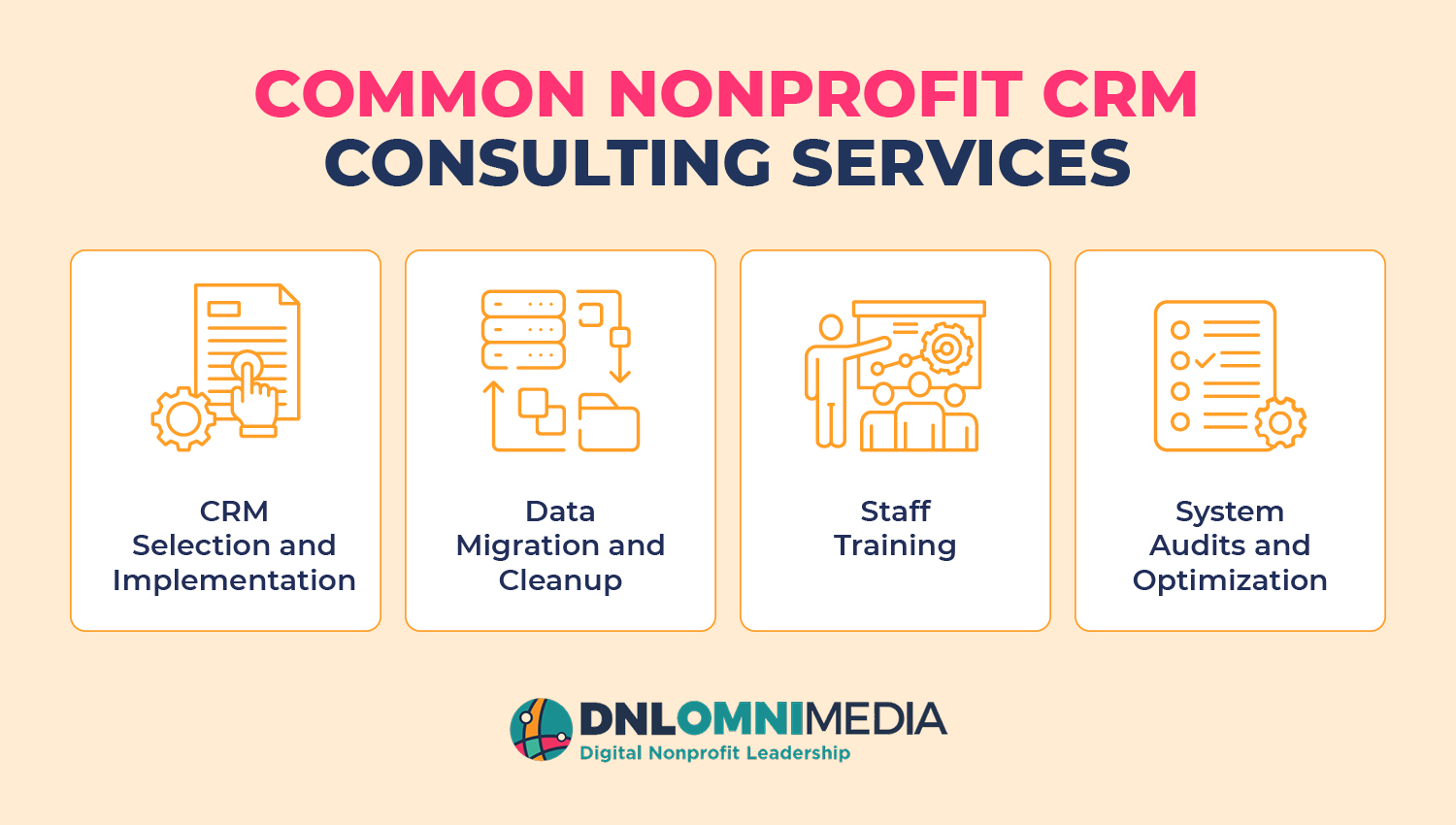
- CRM selection and implementation: A CRM consultant will assess your nonprofit’s needs and current CRM to understand your daily workflows and challenges. Then, they’ll compile a list of CRMs based on your needs, budget, and team size. Once you’ve chosen a CRM, the consultant will handle implementation by configuring settings, setting up user permissions, customizing fields, and creating integrations.
- Data migration and cleanup: Nonprofit CRM consultants can also play a big role in migrating your nonprofit’s donor data between tools. They begin by evaluating your existing data and collaborating with your team to refine it. Then, they map out the data migration and how your data will appear in your new tool. Finally, they’ll run migration tests with small batches of data, and then fully transfer your data over to your new tool.
- Staff training: Learning how to use a new CRM can be complicated and stressful. Your nonprofit CRM consultant will help by hosting dedicated training sessions for your key team members, ensuring they know how to use the tool to its full potential. You may also ask your consultant to put together training and process documents that you can refer to after your engagement has ended.
- System audits and optimization: These services are designed for nonprofits that already have a CRM and want to optimize it, especially if it’s a particularly complex tool (such as Blackbaud). Your CRM consultant will audit your existing processes and conduct interviews with your teams to identify the largest gaps. Then, they’ll create a final report that outlines what’s broken, what’s working, and a plan to fix them. You can then decide whether to handle these issues on your own or have the consultant assist you.
Certain consultants may also offer standalone services, such as building custom integrations or providing ongoing administrative support. When you decide to hire a CRM consultant, think through exactly what type of assistance you need from them, and use those details to inform your search for the right consultant.
The Process of Hiring a Nonprofit CRM Consultant: 3 Steps

1. Align On Your Consultant Needs Internally
If you’re considering hiring a CRM consultant, you’ve likely already experienced challenges with your donor data, processes, or strategy when using your current tools. However, that doesn’t mean you should immediately dive into research. Instead, create a plan that includes the following details:
- The goal, which is what you aim to accomplish by hiring a nonprofit CRM consultant.
- The problem, which refers to the challenges you’re experiencing and how they impact your mission.
- The scope, which includes the consulting services you need, any non-negotiable features you want in your CRM, and a list of features that you’d like to have.
- The people, which refers to internal team members who will be in charge of this project. This team might include a project lead, a steering committee, and a system administrator who will handle CRM-related issues after the consultant’s work is done.
- The logistics, which include a budget for your project (covering consulting fees and CRM fees) and your timeline (including any hard deadlines).
This plan will clearly lay out what you hope to achieve through CRM consulting and why it’s critical for your nonprofit to hire a consultant. This makes it easier for you to obtain leadership buy-in and establish internal alignment as you move forward with the process.
2. Research and Create a Shortlist
Once you’ve received the go-ahead from your leadership team, you can start putting together a shortlist of nonprofit CRM consultants you’d like to work with. As you conduct your research, ask the following questions to determine if the consultant would be a good fit for your needs:
- Do the services they offer line up with my nonprofit’s needs?
- Is the consultant a platform specialist or platform agnostic? For example, do they only work with Salesforce? Or are they an objective expert who can help you choose from several platforms?
- Do they have nonprofit-specific experience?
- How does the consultant describe their process, and does it align with what you’re looking for?
- Does the consultant offer long-term support, and if so, what does this support look like?
- Are there case studies or testimonials you can review to get a sense of how the consultant works? Are there any organizations like yours featured in those resources?
Depending on their needs, nonprofits will want different answers to these questions. However, one non-negotiable is that the consultant must be a good listener and collaborator. You want to work with an expert who will consider your thoughts as they suggest big changes to one of your organization’s most important tools. They should be open to your feedback, as your CRM will significantly impact how you handle fundraising, marketing, stewardship, and strategy.
3. Dig Deeper and Make a Decision
After you’ve created your shortlist, dig deeper into each consultant to determine which one is the best fit. You can do this in three ways:
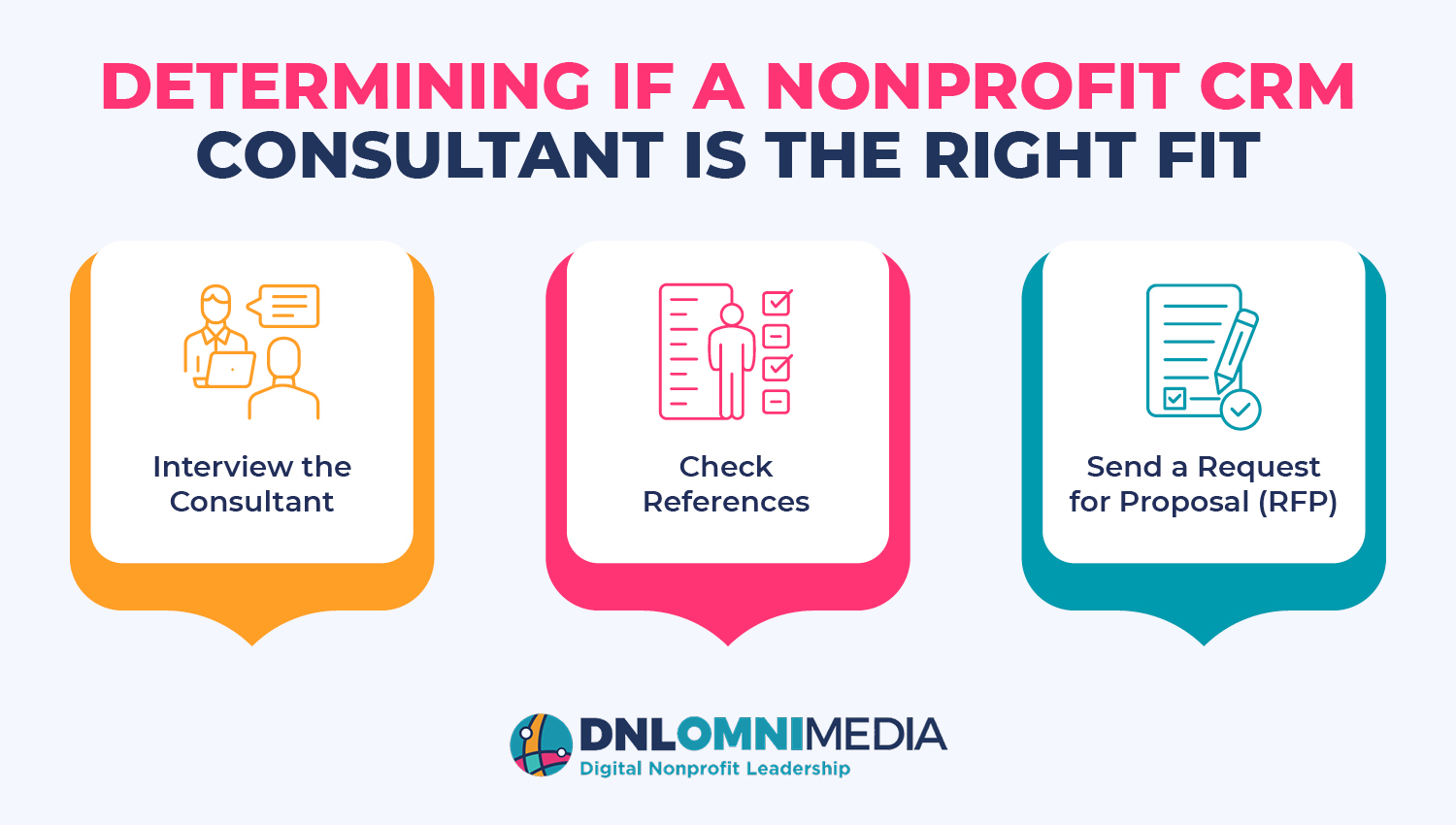
- Interview the consultant: Schedule a call with the CRM consultant and ask any questions you may have about their process and case studies. This is a great opportunity to hear directly from the consultant and gain a deeper understanding of their approach. You may also ask them for a few references to contact for a better understanding of their work.
- Check references: Book appointments or schedule calls with the consultant’s references. Ask these organizations about how their experience with nonprofit CRM consulting went and if they’re still happy with the work the consultant did.
- Send a request for proposal (RFP): At this point, you’ve probably greatly narrowed down your shortlist. Choose the two or three most promising candidates and send them an RFP. Once their proposals return, review them and determine which one is the best fit for your needs.
After going through this process, your nonprofit should be able to confidently select a partner for nonprofit CRM consulting. However, if you still have concerns or if the proposals you receive have issues, you can set up another meeting with the consultant to address your concerns. They will be able to adjust the proposal accordingly.
You may also consider starting with a small project to assess how the consultant works with your nonprofit. This will give you the confidence to proceed with them on a larger project, or let you know that you should not work with them in the future.
Partnering with DNL OmniMedia for Nonprofit CRM Consulting
Choosing to configure your current CRM or migrate to a new one is among the most important decisions your nonprofit can make. When your nonprofit is already busy with service delivery, development, marketing, fundraising, and advocacy, it’s difficult to dedicate the time and effort required to make these critical decisions.
If you’re searching for an expert nonprofit CRM consulting partner, look no further than DNL OmniMedia.
Team DNL brings decades of expertise in nonprofit CRM consulting and data management, helping organizations migrate, integrate, and optimize their CRM systems for efficiency and stability. We offer various CRM consulting services, including:
- CRM strategy and roadmap development
- CRM maturity and health assessments
- Data governance consulting
- CRM data migration and integrations
- Data cleanup and deduplication
- Complex CRM customization
- Custom apps and integrations
- Change management, user training, and enablement
- Fractional CRM administration
- CRM optimization and custom reporting
- Cybersecurity, domain, and data management
We have years of experience working with nonprofit CRMs like Salesforce Nonprofit Cloud, Blackbaud’s Raiser’s Edge NXT, Luminate Online, Bonterra EveryAction, HubSpot, and more. Our flexible engagements include end-to-end support, from strategy all the way to training.
Plus, CRM consulting isn’t the only way you can transform your nonprofit with Team DNL. We also offer plenty of other services, including website development, fundraising, marketing, and analytics.
Additional Resources to Enhance Your Nonprofit CRM Management
Having an optimized CRM fuels your nonprofit’s success, which is why investing in nonprofit CRM consulting is worthwhile for most organizations. With an expert’s experience and knowledge, you can rest assured that you’re making the most of your systems, leading to more efficient decision-making and operations across your nonprofit.
To learn more about nonprofit CRM consulting, explore these additional resources:
- Nonprofit Consulting Firms: 25+ Top Options To Choose From
- Find the Right Salesforce Nonprofit Consulting Firm: 7 Steps
- Blackbaud Consulting Services: A Nonprofit’s Guide