

60% of nonprofits agree that AI will greatly benefit the sector as a whole. To ensure your mission-driven organization does not get left behind, now is the time to adapt to these new technology trends.
However, getting started with an AI fundraising tool can feel daunting. To alleviate your concerns and address your questions, this guide will cover the following topics:
- AI for Fundraising FAQs
- How to Use AI for Fundraising
- How to Leverage AI Fundraising Responsibly
- How to Determine If You’re Ready to Use AI for Fundraising
- AI Fundraising and Team DNL: How We Can Help
When leveraged responsibly and ethically, AI provides nonprofits with an unparalleled opportunity to advance their missions. Let’s start your journey with AI fundraising by addressing common questions.
AI for Fundraising FAQs
What are the main types of AI tools for fundraising?
Nonprofits primarily use two types of AI tools:
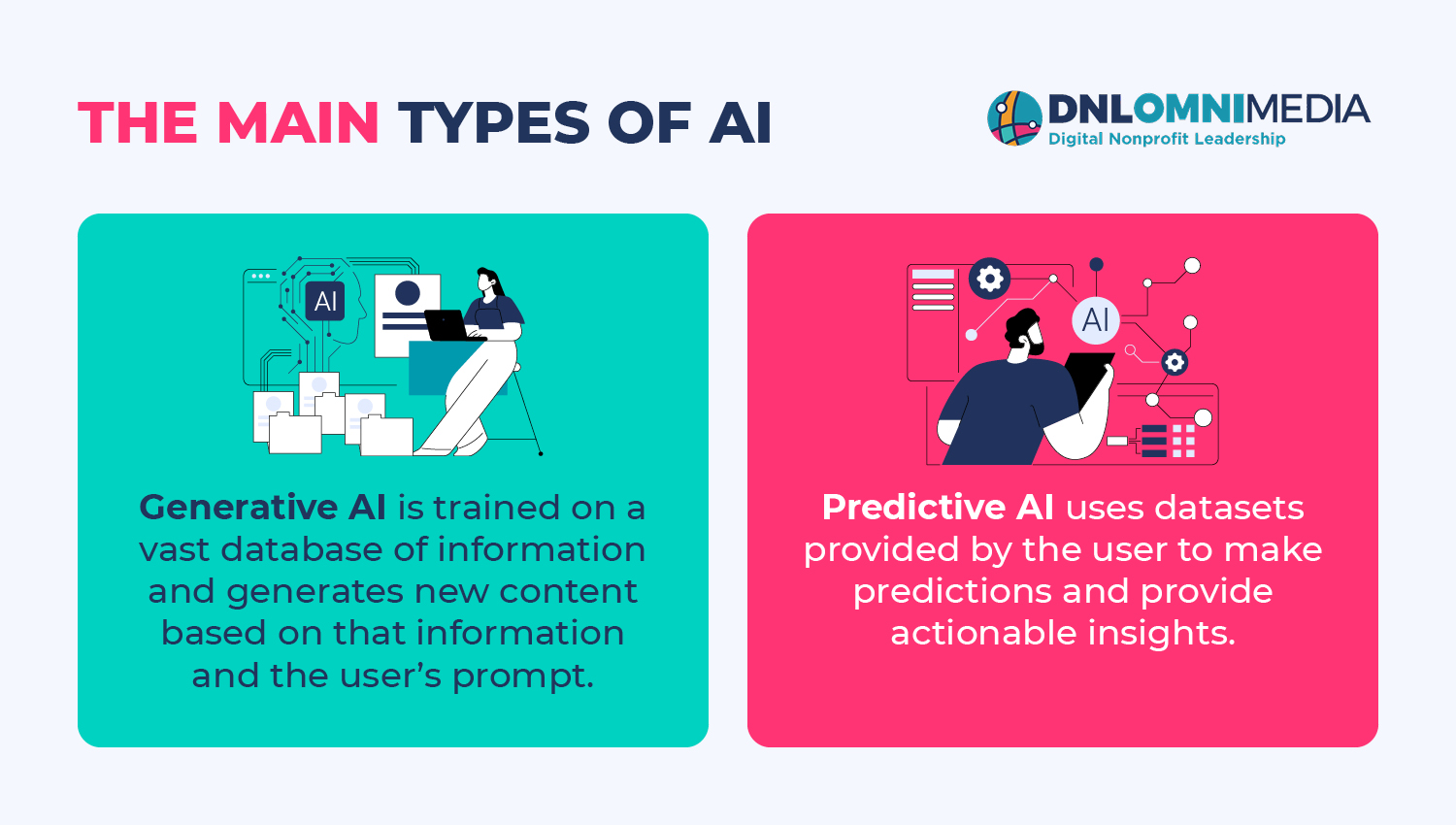
- Generative: When most people think of AI, they envision generative AI tools like ChatGPT and other LLMs. Generative AI is trained on a vast database of information and generates new content based on that database. For instance, ChatGPT can create text, images, videos, audio, and more.
- Predictive: Just as generative AI tools generate new content, predictive AI tools make predictions based on their data sets. Typically, organizations feed predictive AI tools their existing datasets (such as your donor data from your CRM) or information collected from trustworthy third-party sources. The tool then provides insights that the nonprofit can use to improve its fundraising efforts.
Most nonprofits can benefit from using a combination of these two types of AI tools in their fundraising strategies.
What are the benefits of using AI for fundraising?
Using AI for fundraising can lead to these benefits:
- Higher ROI: AI tools make it easy to pinpoint fundraising opportunities, helping drive more funding while saving time and resources.
- Increased efficiency: By automating repetitive tasks such as data entry, meeting summarization, and initial content drafting, your staff can improve their work efficiency.
- Better fundraising strategies: Predictive AI analytics provides real-time insights into donor behavior and campaign performance, empowering you to make informed decisions that yield more funding.
- Improved donor retention: AI enables personalization at scale by helping you tailor messages to every individual supporter based on their specific interests and engagement history, resulting in deeper connections and higher donor retention.
Is using AI tools for fundraising ethical?
Yes, it’s possible to use AI tools ethically. The risk of using AI for fundraising generally comes from violating donor trust by providing a third-party tool with their confidential information without their consent. Implement an “Acceptable Use Policy” that outlines how you plan to mitigate this issue—more on this later.
Will AI replace fundraising staff?
No, but AI tools will make their work easier. AI tools are designed to assist humans, not eliminate their roles entirely.
For example, your AI tools might automate repetitive administrative tasks or rapidly analyze massive datasets, freeing up your staff members to focus on other responsibilities. Additionally, companies and nonprofits that use AI tools ethically typically require human oversight for work conducted by AI.
How to Use AI for Fundraising
There are many different ways you can leverage AI for fundraising, including:
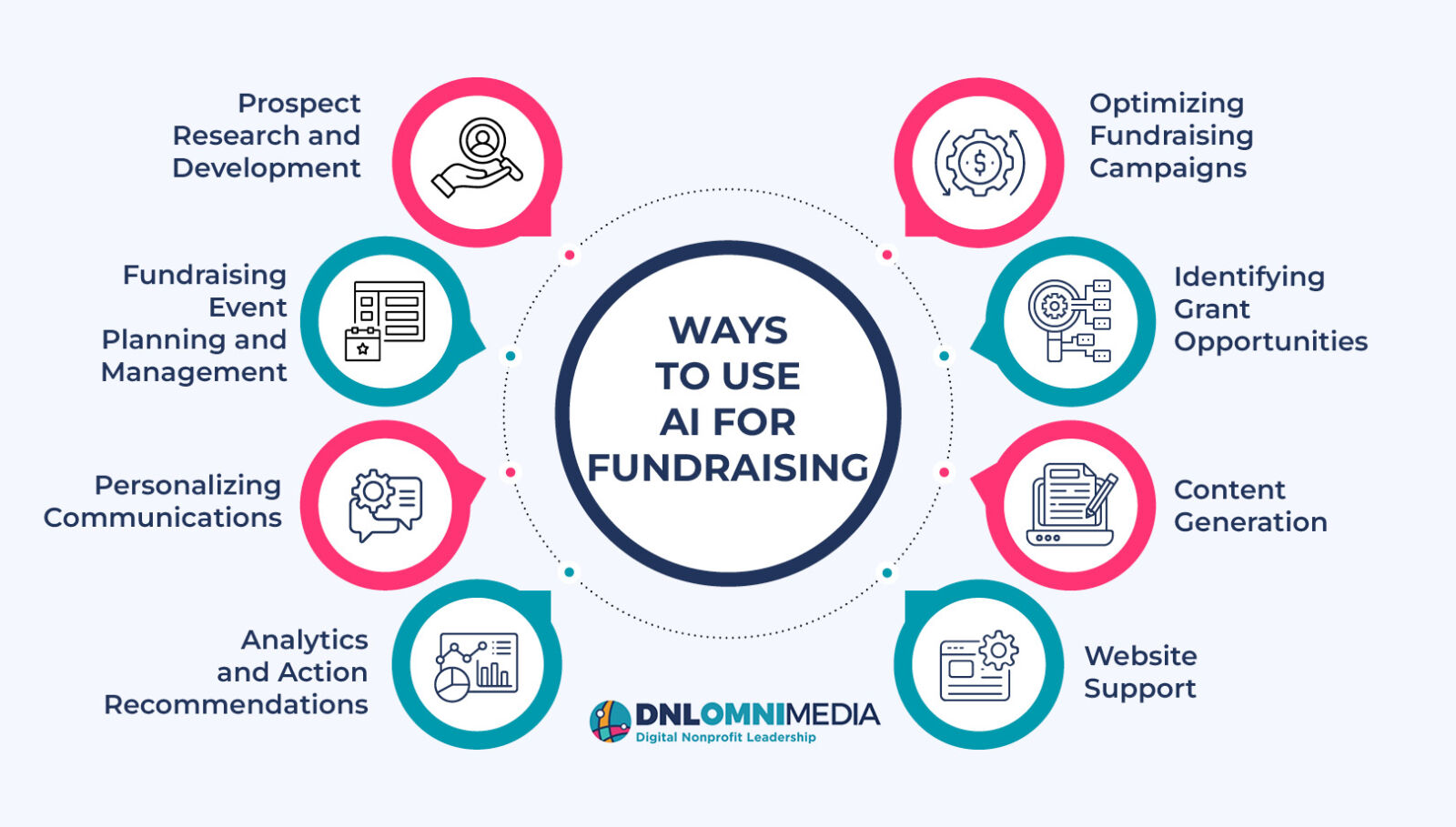
Prospect Research and Development
Predictive AI tools can enhance your prospect research and development processes by helping you understand potential donors’ wealth and philanthropic backgrounds. An AI-powered predictive modeling tool can pinpoint which donors are the best candidates for major gift solicitations and even provide giving likelihood scores.
You can also leverage AI to segment donors by demographics, interests, donor journey stage, and more. Couple predictive and generative AI tools to create personalized content that moves supporters through the donor funnel, inspiring more gifts from your community.
Optimizing Fundraising Campaigns
AI fundraising tools can help you evaluate previous campaign strategies by analyzing campaign data, budgets, supporter feedback, and more. Apply your AI-driven insights to your upcoming efforts to optimize your campaigns for greater revenue.
Fundraising Event Planning and Management
Similarly to optimizing campaigns, AI fundraising tools can take a similar approach to fundraising event planning. Use AI to assess previous events and plan future ones, from brainstorming event ideas to creating a budget and a preliminary marketing plan.
Identifying Grant Opportunities
Grant research is a time-consuming process, and fortunately, AI tools can streamline it. Predictive AI tools can analyze grant databases of foundations, corporations, government entities, and more to match your nonprofit with relevant opportunities.
AI tools can also be used to draft initial grant proposals, summarize your nonprofit’s accomplishments, and brainstorm language to fit each grantmaker’s specific requirements and interests. This saves your staff time and gives them a head start on the application process.
Personalizing Communications
AI’s ability to analyze large amounts of donor information allows for greater communication personalization. Once your AI fundraising tool processes your donor data—including past giving history, communication preference, event attendance, and interests—you can use generative AI tools to draft tailored outreach to deepen supporter relationships.
Content Generation
In addition to creating personalized donor messages, you can also leverage AI to make other types of content, like social media posts. With the help of AI, staff members can quickly create first drafts that can be edited to fit your unique mission and audience. This increases the volume of content your team can put out.
Analytics and Action Recommendations
Predictive AI excels at transforming raw data into actionable insights. With the right tools, you can predict donor churn, get recommendations for when to make fundraising asks, optimize your A/B tests, and more. AI can transform how your nonprofit views and handles analytics, enabling you to prioritize your highest-ROI opportunities and make smarter decisions about how to approach them.
Website Support
AI can dramatically enhance your nonprofit’s website’s functionality and user experience, turning it into an effective fundraising and engagement platform. In particular, AI-powered chatbots can provide instant, 24/7 support to all website visitors. Not only does this create a better, more accessible experience for visitors, but it also reduces the time your staff spends fielding phone calls and other simple communications.
How to Leverage AI Fundraising Responsibly
Although using AI for fundraising has many benefits, AI is still a relatively new technology, and many individuals are understandably wary of it. For example, a key concern for nonprofits is data security. If confidential donor data is provided to AI tools and is not treated sensitively, it can cause irreparable harm to a nonprofit’s reputation.
To mitigate the risks of using AI, establish clear use policies and oversight processes. Here are the three main pillars you should focus on:
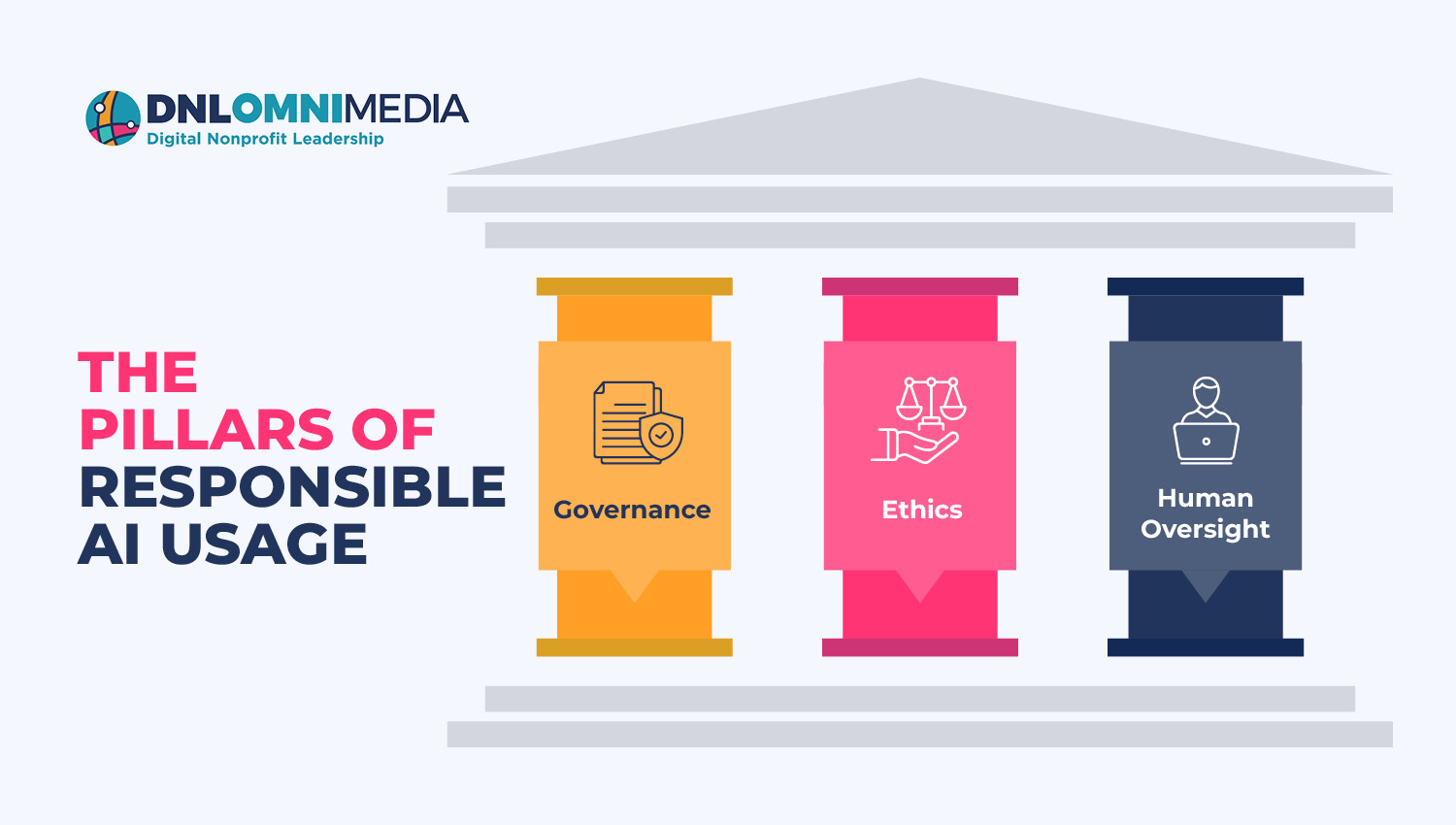
- Governance: Establish clear rules and processes for how AI tools are selected, implemented, and used. Most organizations will create an Acceptable Use Policy that defines how staff members can and cannot use AI tools. Then, periodically review AI usage and outputs to ensure that your policy is being followed and that the tools are producing useful, unbiased, and accurate results. You should also screen your AI tools to ensure they comply with relevant data protection regulations.
- Ethics: Your nonprofit must ensure AI systems are fair, transparent, and accountable. This means being open with your community about when and how AI is used and quickly addressing any negative consequences that arise from its use. Also, be aware that AI models can reflect biases present in training data, so routinely assess your data and models for bias.
- Human oversight: It’s crucial to have humans oversee all AI work. Never send out AI-generated content without human review, and have employees vet AI outputs for accuracy, tone, mission alignment, and compliance with other ethical standards before using it.
In addition to following these best practices, train employees to use your new AI tools so they fully understand how they work and can recognize potential pitfalls. When employees understand why responsible AI use matters, they’ll be more likely to follow your policies.
How to Determine If You’re Ready to Use AI for Fundraising
Some organizations might feel uncertain about using AI for fundraising. Maybe you feel that your employees aren’t ready to make the change or that you need more preparation. Take a look at the statements below; if you agree with them, then you’re ready to use AI for fundraising.
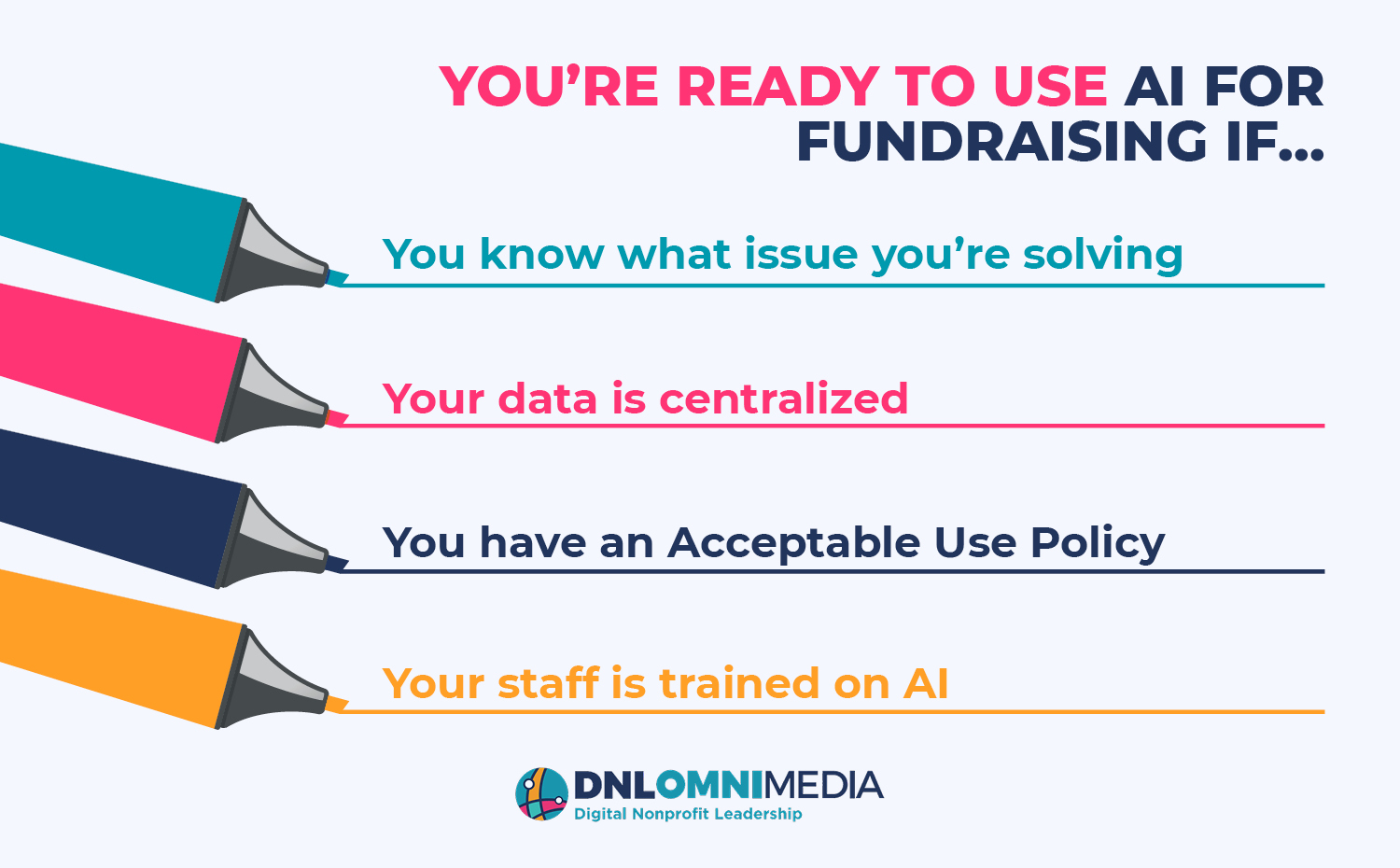
- You know what issue you’re solving: Assess your needs and budget to gain a clear idea of what type of AI fundraising tool you want to invest in and what it will help your nonprofit accomplish. For instance, if your nonprofit mostly acquires funding through grants and spends the majority of its time writing grant proposals, you may choose an AI tool designed to research grant databases.
- Your data is centralized: Siloed or incomplete data can lead to bias or skewed AI results. Assess your current data management policies, including ones on governance, retention, and hygiene. Then, unify your data in a single solution or resource for more accurate AI insights.
- You have an Acceptable Use Policy: Before investing in an AI solution, you should already have a draft of your Acceptable Use Policy that outlines exactly what staff can and cannot do with AI. You may need to tweak the policy depending on the AI fundraising tool you purchase, but the bones of it should already be established.
- Your staff is trained on AI: Securing employee buy-in is essential for a big change like investing in AI tools. Your staff may have their own feelings and misgivings about using AI, so it’s important to give them training to both alleviate their concerns and empower them to use AI responsibly and effectively.
If you’re still uncertain about whether your organization is ready to invest in AI for fundraising, consider having an external party assess your readiness. That’s where Team DNL can help.
AI Fundraising and Team DNL: How We Can Help
While most nonprofits are dabbling with AI fundraising tools, not all are finding fundraising success. With DNL OmniMedia’s guidance, your nonprofit can unlock the power of AI to raise more, work smarter, and increase your mission’s impact.
We offer an eight-week AI Readiness and Roadmap program to get your AI fundraising strategy off the ground. Our program comes in three phases:
- Assessment: We’ll review your current tech stack, staff knowledge, and governance baseline to determine your nonprofit’s readiness to implement AI. We’ll also provide a leadership primer on AI’s role in fundraising.
- Use cases: Together, we’ll explore fundraising AI use cases suited to your mission and how to best boost efficiency for your development teams. We’ll look at how you can automate prospect research, donor giving likelihood scoring, segmentation, and personalized content generation.
- Roadmap and adoption: We provide you with staff training modules, “day in the life” guides for gift officers and development directors, and safe and ethical AI usage guidelines. Team DNL will also support you through change management to acquire employee buy-in and ensure smooth adoption.
DNL OmniMedia can also help you implement AI and provide dedicated support to ensure successful adoption across teams. Even after a successful implementation, we can continue to provide ongoing advice and quarterly AI roadmap refreshes to ensure you’re making the most of your tools.
Additional Fundraising Resources
AI fundraising tools may seem intimidating, but the benefits they provide make them well worth researching and implementing. If you need additional guidance on how to implement AI into your fundraising strategy, Team DNL is always here to help.
To learn more about nonprofit tech and fundraising, explore these resources:
Nonprofit Consulting Firms: 25+ Top Options To Choose From.
If you’re feeling uncertain about your next steps, nonprofit consultants can provide the expertise you need. Discover the top consulting firms you can work with.
Strengthen Your Nonprofit Fundraising Strategy: 8 Key Steps.
AI tools are valuable, but only if you’ve done the work to establish a strong fundraising strategy. Learn how to strengthen your plans here.
Nonprofit Analytics: How to Use Data to Improve Your Org.
Not sure how to maximize the value of your data? This guide teaches you how to improve your nonprofit with data.
Common AI Fundraising Questions
What is AI fundraising for nonprofits?MoreLess
AI fundraising refers to the use of artificial intelligence tools to analyze data, automate tasks, personalize outreach, and improve fundraising strategies. These tools help nonprofits make smarter, data-driven decisions to increase efficiency and donor engagement.
What types of AI tools are used in fundraising?MoreLess
Nonprofits primarily use two types of AI tools. Generative AI creates content such as emails, reports, or campaign materials. Predictive AI analyzes data to identify trends, forecast donor behavior, and uncover fundraising opportunities.
What are the benefits of using AI for fundraising?MoreLess
AI can help nonprofits increase fundraising ROI, improve operational efficiency, gain deeper insights into donor behavior, and deliver more personalized engagement. These benefits support stronger campaigns and higher donor retention.
How does AI improve donor engagement?MoreLess
AI enables nonprofits to personalize communication at scale by analyzing donor preferences, engagement history, and giving patterns. This allows organizations to send more relevant messages that build stronger relationships with supporters.
Is AI fundraising ethical for nonprofits?MoreLess
AI fundraising can be used ethically when organizations prioritize responsible data usage, transparency, and governance. Nonprofits should ensure that AI supports their mission and maintains trust with donors and stakeholders.
How can nonprofits get started with AI in fundraising?MoreLess
Nonprofits can begin by evaluating their current technology, identifying high-impact use cases, and starting with simple tools that address immediate needs. Building a clear strategy and ensuring staff readiness are key steps for successful adoption.
How does AI help improve fundraising strategy?MoreLess
AI provides real-time insights into donor behavior and campaign performance, enabling nonprofits to make informed decisions. By identifying patterns and opportunities, organizations can refine their strategies to drive better outcomes.